

Official WeChat
About Malaysia's CIDB
PublishDate:2026-05-29
Source:Sinoma Energy Conservation Ltd.
I. Core Functions of CIDB
CIDB stands for the Construction Industry Development Board. It operates in compliance with the Construction Industry Development Board Act 1994 (Act 520) and the Customs Act 1967 (Act 235). Its core functions fall into four categories:
Industry Regulation
Formulate regulations governing the entire construction lifecycle, review contractors’ qualifications, and supervise compliance inspection and acceptance of construction projects.
Quality Certification
Implement mandatory certification for imported building materials, issue Certificates of Approval (COA), conduct sampling tests on imported products, and manage product traceability.
Talent Development
Promote vocational skills training for practitioners. It requires that 30% of employees within a contractor’s workforce hold valid CIDB certificates, and foreign skilled workers must obtain separate CIDB skill certifications.
Policy Implementation
Execute the National Construction Policy 2030 (NCP 2030) and drive digital transformation across the industry, including the application of Building Information Modeling (BIM) and Industrialised Building System (IBS).
II. Scope of Governance of Malaysia's CIDB
Pursuant to Act 520, CIDB adopts a broad definition of "construction works", covering nearly all construction activities such as building construction, civil engineering, electromechanical installation, demolition, maintenance, piping, road works and port development.
The scope includes but is not limited to:
Residential buildings: Villas, apartments and residential towers;
Commercial buildings: Office buildings, shopping malls and hotels;
Infrastructure projects: Roads, bridges, high-speed railways and more;
Industrial buildings: Factories, warehouses and similar facilities.
(1) Regulated Entities
General contractors, specialist subcontractors, as well as suppliers providing installation services are all subject to CIDB supervision. Notably, CIDB determines whether an entity qualifies as a "contractor" based on its actual on-site activities rather than the name of the contract. An enterprise will be deemed to be engaged in construction works and obligated to complete CIDB registration if it performs substantive construction-related duties, such as deciding on construction plans on site, directly managing project progress and work safety, or issuing work instructions to construction personnel.
(2) Scope of Mandatory Certification for Construction Products
In addition to contractor registration, CIDB enforces mandatory certification for 70 types of building materials across 13 major categories, including steel products, ceramic goods, cement and concrete products, thermal insulation materials, architectural glass and aluminium products.
Any construction product without a valid Certificate of Approval (COA) or other relevant certifications is prohibited from import and on-site use. Violators will face consequences including customs clearance suspension, heavy fines and even product recalls. For Chinese enterprises exporting building materials, product compliance is equally critical as contractor registration.
III. Standard Application Procedure for COA
All imported building materials subject to mandatory certification must follow the standard CIDB procedure below:
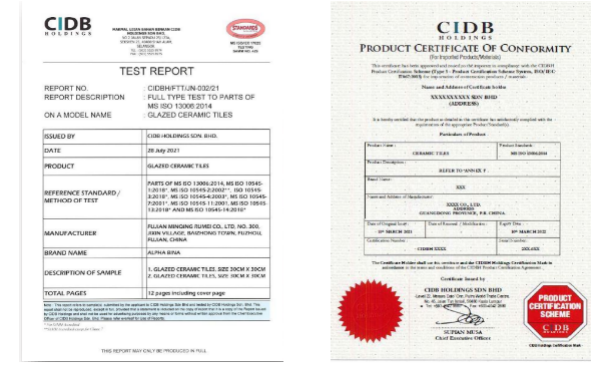
Importers shall first complete registration with CIDB and subscribe to the ePermit service via Dagang Net, Malaysia’s official customs network platform. Afterwards, applicants upload product documents (e.g. PCL certificates, FTTR reports) and submit online applications through the CIDB system.
Applications undergo a two-tier review process:
The first tier: Frontline CIDB auditors verify the completeness of submitted documents.
The second tier: Senior CIDB officials review technical compliance.
Upon approval, a COA will be issued. Importers may then complete customs clearance with the valid COA.